


By Todd Rope, Vice President of Software Engineering at Marvell
Optical circuit switching (OCS) has become one of the fastest growing segments in networking with revenue expected to exceed $3.5 billion by 2029, more than 2x over 2025.1 The unique architecture of OCS systems, however, also mean that developers and data center operators need to ensure that these systems can seamlessly integrate into data infrastructure and interoperate with existing product lines.
Lumentum and Marvell took a significant step toward that goal with a live demonstration at OFC 2026 that combined the R300 OCS system from Lumentum with different classes of modules powered by Marvell optical DSPs. The modules included inside-the-data center modules powered by the Marvell® Ara 1.6T (5m-2km interconnects), coherent lite modules with 1.6T Marvell Aquila for campus-size connections (2 to 20km) and long-range COLORZ® 800T ZR/ZR+ modules for 10-1000km data center interconnects.
Marvell RELIANT™, a new software platform for analyzing equipment performance and optimizing networks in real-time, was also used to monitor data transmission, power consumption, bit error rate and other metrics in the demo. Michael DeMerchant, senior director of product line management at Lumentum and I walk you through more of what RELIANT can accomplish with OCS in the video.
By Nicola Bramante, Senior Principal Engineer, Connectivity Marketing, Marvell
Why develop a hybrid cable? Because the quest for greater optimization in AI data centers never ends.
High speed cable developer and manufacturer Luxshare-Tech and Marvell showed off the industry’s first hybrid AEC/ACC solution at OFC 2026, the latest step in enhancing copper interconnects to meet the stringent power, performance and reach standards of AI infrastructure.
Active electrical cables (AECs) are designed for comparatively long (~4-9 meter) high-bandwidth connections within or between racks. The boost in reach over passive copper cables is accomplished by integrating optimized AEC DSPs into the terminal ends of a cable. Active Copper Cables (ACCs), by contrast, rely on equalizers and redrivers for extending reach. ACCs consume far less power than AECs but generally are deployed for in-rack connections running 2 meters or less.
Hybrid AEC/ACC cables combine technologies from both for a solution that delivers a longer, AEC-like reach and the low latency, low power, low cost and low complexity benefits of ACC designs.
By Kirt Zimmer, Head of Social Media Marketing, Marvell
The OFC 2025 event in San Francisco was so vast that it would be easy to miss a few stellar demos from your favorite optical networking companies. That’s why we took the time to create videos featuring the latest Marvell technology.
Put them all together and you have a wonderful film festival for technophiles. Enjoy!
Annie Liao — Product Management Director, Connectivity Marketing at Marvell — showcased how PCIe Gen6 signals can be converted to optical—extending trace length beyond traditional electrical limitations. The result? A 10-meter cable reach spanning across multiple racks. Whether connecting GPUs, accelerators, or storage across racks, this kind of extended PCIe connectivity is critical for building the infrastructure that powers advanced AI workloads.
By Michael Kanellos, Head of Influencer Relations, Marvell
You’re likely assaulted daily with some zany and unverifiable AI factoid. By 2027, 93% of AI systems will be able to pass the bar, but limit their practice to simple slip and fall cases! Next-generation training models will consume more energy than all Panera outlets combined! etc. etc.
What can you trust? The stats below. Scouring the internet (and leaning heavily on 16 years of employment in the energy industry) I’ve compiled a list of somewhat credible and relevant stats that provide perspective to the energy challenge.
1. First, the Concerning News: Data Center Demand Could Nearly Triple in a Few Years
Lawrence Livermore National Lab and the Department of Energy1 has issued its latest data center power report and it’s ominous.
Data center power consumption rose from a stable 60-76 terawatt hours (TWh) per year in the U.S. through 2018 to 176 TWh in 2023, or from 1.9% of total power consumption to 4.4%. By 2028, AI could push it to 6.7%-12%. (Lighting consumes 15%2.)
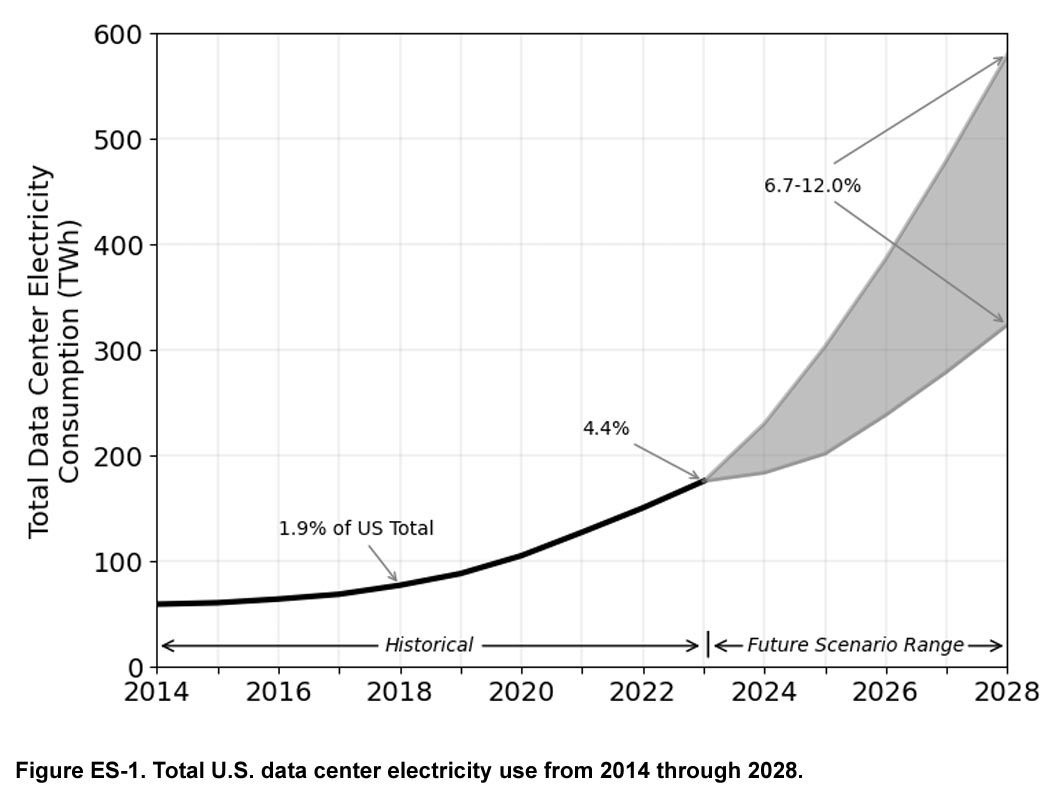
Report co-author Eric Masanet adds that the total doesn’t include bitcoin, which increases 2023’s consumption by 70 TWh. Add a similar 30-40% to subsequent years too if you want.
This article was originally published in VentureBeat.
Artificial intelligence is about to face some serious growing pains.
Demand for AI services is exploding globally. Unfortunately, so is the challenge of delivering those services in an economical and sustainable manner. AI power demand is forecast to grow by 44.7% annually, a surge that will double data center power consumption to 857 terawatt hours in 20281: as a nation today, that would make data centers the sixth largest consumer of electricity, right behind Japan’s2 consumption. It’s an imbalance that threatens the “smaller, cheaper, faster” mantra that has driven every major trend in technology for the last 50 years.
It also doesn’t have to happen. Custom silicon—unique silicon optimized for specific use cases—is already demonstrating how we can continue to increase performance while cutting power even as Moore’s Law fades into history. Custom may account for 25% of AI accelerators (XPUs) by 20283 and that’s just one category of chips going custom.
The Data Infrastructure is the Computer
Jensen Huang’s vision for AI factories is apt. These coming AI data centers will churn at an unrelenting pace 24/7. And, like manufacturing facilities, their ultimate success or failure for service providers will be determined by operational excellence, the two-word phrase that rules manufacturing. Are we consuming more, or less, energy per token than our competitor? Why is mean time to failure rising? What’s the current operational equipment effectiveness (OEE)? In oil and chemicals, the end products sold to customers are indistinguishable commodities. Where they differ is in process design, leveraging distinct combinations of technologies to squeeze out marginal gains.
The same will occur in AI. Cloud operators already are engaged in differentiating their backbone facilities. Some have adopted optical switching to reduce energy and latency. Others have been more aggressive at developing their own custom CPUs. In 2010, the main difference between a million-square-foot hyperscale data center and a data center inside a regional office was size. Both were built around the same core storage devices, servers and switches. Going forward, diversity will rule, and the operators with the lowest cost, least downtime and ability to roll out new differentiating services and applications will become the favorite of businesses and consumers.
The best infrastructure, in short, will win.
The Custom Concept
And the chief way to differentiate infrastructure will be through custom infrastructure that are enabled by custom semiconductors, i.e., chips containing unique IP or features for achieving leapfrog performance for an application. It’s a spectrum ranging from AI accelerators built around distinct, singular design to a merchant chip containing additional custom IP, cores and firmware to optimize it for a particular software environment. While the focus is now primarily on higher value chips such as AI accelerators, every chip will get customized: Meta, for example, recently unveiled a custom NIC, a relatively unsung chip that connects servers to networks, to reduce the impact of downtime.

